
Best ChatGPT Rank Tracking Tool in 2026 (And What “Ranking” Even Means Now)
Your competitors are being recommended in ChatGPT right now. Here's how to find out, and which tools actually tell you what to do about it.

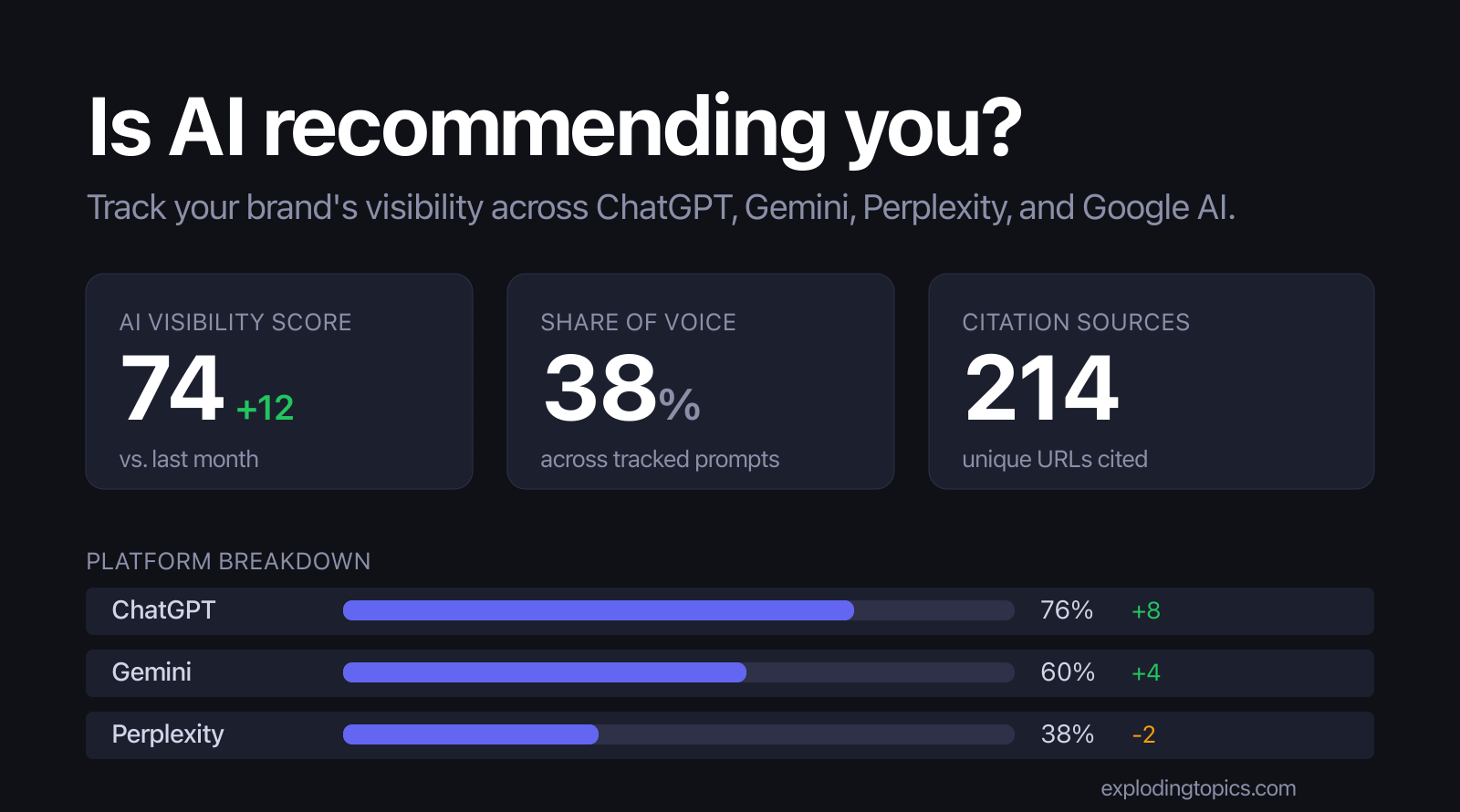
Before you spend $100+ a month on a rank tracking tool, do this first:
Go to the Exploding Topics free AI Visibility Checker and type in your brand name. It takes 30 seconds and tells you whether AI assistants are recommending you, or your competitors, right now. No account required.
That is your baseline. Now let’s talk about what to do with it.
The Problem With “Ranking” in ChatGPT
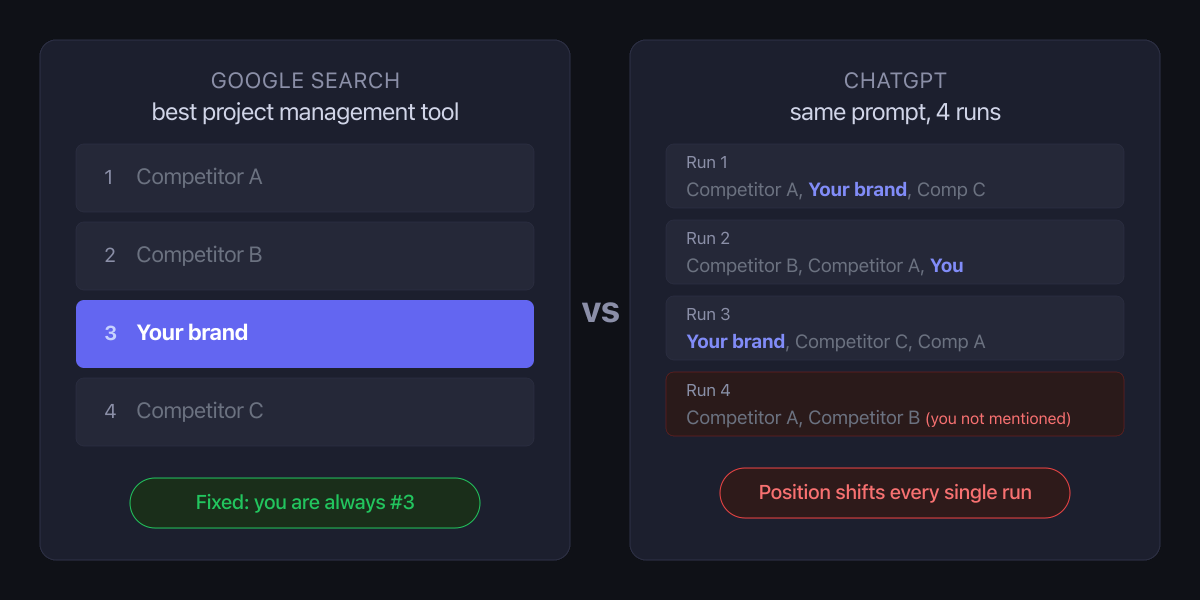
When you rank #3 on Google, that is a fact. Deterministic. Reproducible. You can screenshot it, report it, and track it moving over time.
ChatGPT does not work that way.
Ask ChatGPT “what’s the best project management tool?” three times in a row and you might get three different answers. The same prompt produces different brand orderings, different citations, and sometimes different recommendations entirely, depending on model version, geography, phrasing, and the AI’s inherent randomness.
This is why “ChatGPT rank tracking” is a bit of a misnomer. You are not tracking a position. You are tracking a probability distribution: how often your brand shows up, where in the response, and which sources the model references when it does.
The best tools understand this and track accordingly.
ChatGPT vs. Google AI Overviews: Two Different Problems
Here is where most people conflate two things that require separate strategies.
ChatGPT, Perplexity, Claude, Gemini, and Copilot are answer engines. People ask them questions. The AI synthesizes an answer from its training data and cited sources. Your job is to be mentioned, recommended, or cited.
Google AI Overviews appear at the top of Google search results. They pull from web pages Google can crawl. If Google decides to show an AI Overview for “best CRM for startups,” whoever gets cited there gets the visibility and the traffic.
Google also launched AI Mode in 2025, a dedicated conversational search experience that functions more like ChatGPT but runs on Google’s index. Some tracking tools now monitor AI Mode separately from traditional AI Overviews.
The optimization strategies overlap but are not identical. If you want to track and improve your Google AI Overview rankings specifically, we broke that down in depth here.
For this piece, we are covering tools that track both, because the best ones do.
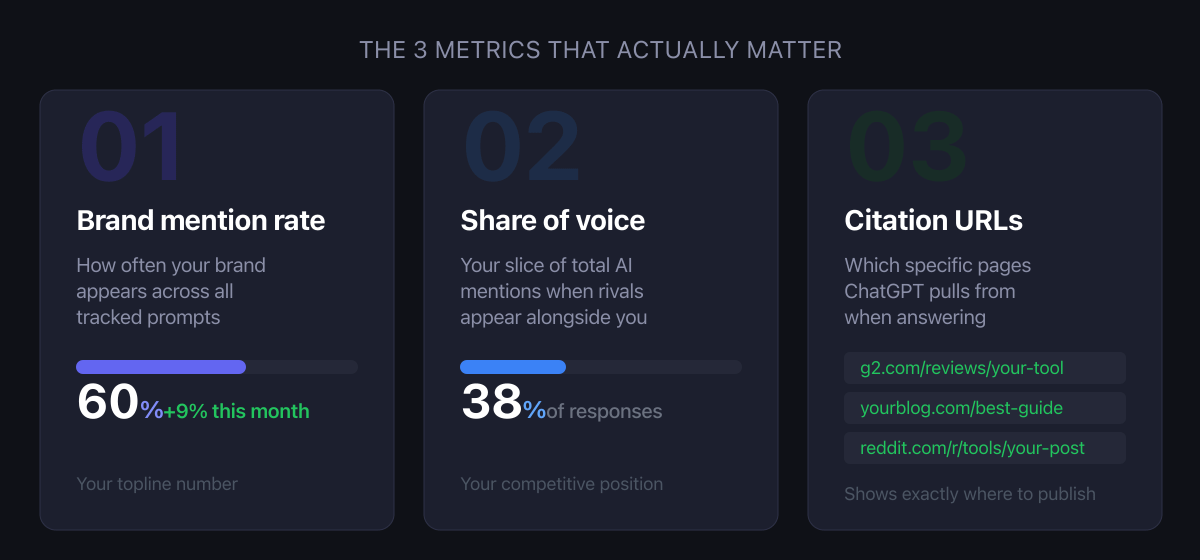
The 3 Metrics That Actually Matter
Every tool in this space will drown you in dashboards. Here is what to actually watch.
Brand Mention Rate
What percentage of relevant prompts include your brand in the response? If you are tracking 50 prompts and appear in 20, that is a 40% mention rate. This is your topline number.
Share of Voice
When competitors appear in the same response as you, what percentage of the total mentions do you own? If three brands are recommended and you are always listed third, your share of voice is low even if your mention rate looks fine.
Citation URLs
This one is underrated. ChatGPT does not just mention brands. It pulls from specific pages when constructing answers. Knowing which URLs the model is referencing tells you exactly what content to create, update, or earn placements on. It is the bridge from “we have a visibility problem” to “here is how to fix it.”
What Prompts Should You Actually Be Tracking?
One thing most comparison articles skip: you have to decide what prompts to track before any tool can help you.
A prompt library is a structured set of questions that real buyers ask when evaluating tools in your category. Think along these lines:
“Best [your category] tools for [use case]”
“[Competitor name] alternatives”
“How do I [solve the problem your product solves]”
“[Your category] for [industry or team size]”
These are the queries where ChatGPT visibility directly affects whether someone adds you to their shortlist. The best tracking tools let you import custom prompts, run them on a schedule, and alert you when your mention rate drops.
Start with 10 to 20 high-intent prompts. Once you see patterns, expand from there.
The Best ChatGPT Rank Tracking Tools in 2026
Semrush AI Visibility Toolkit
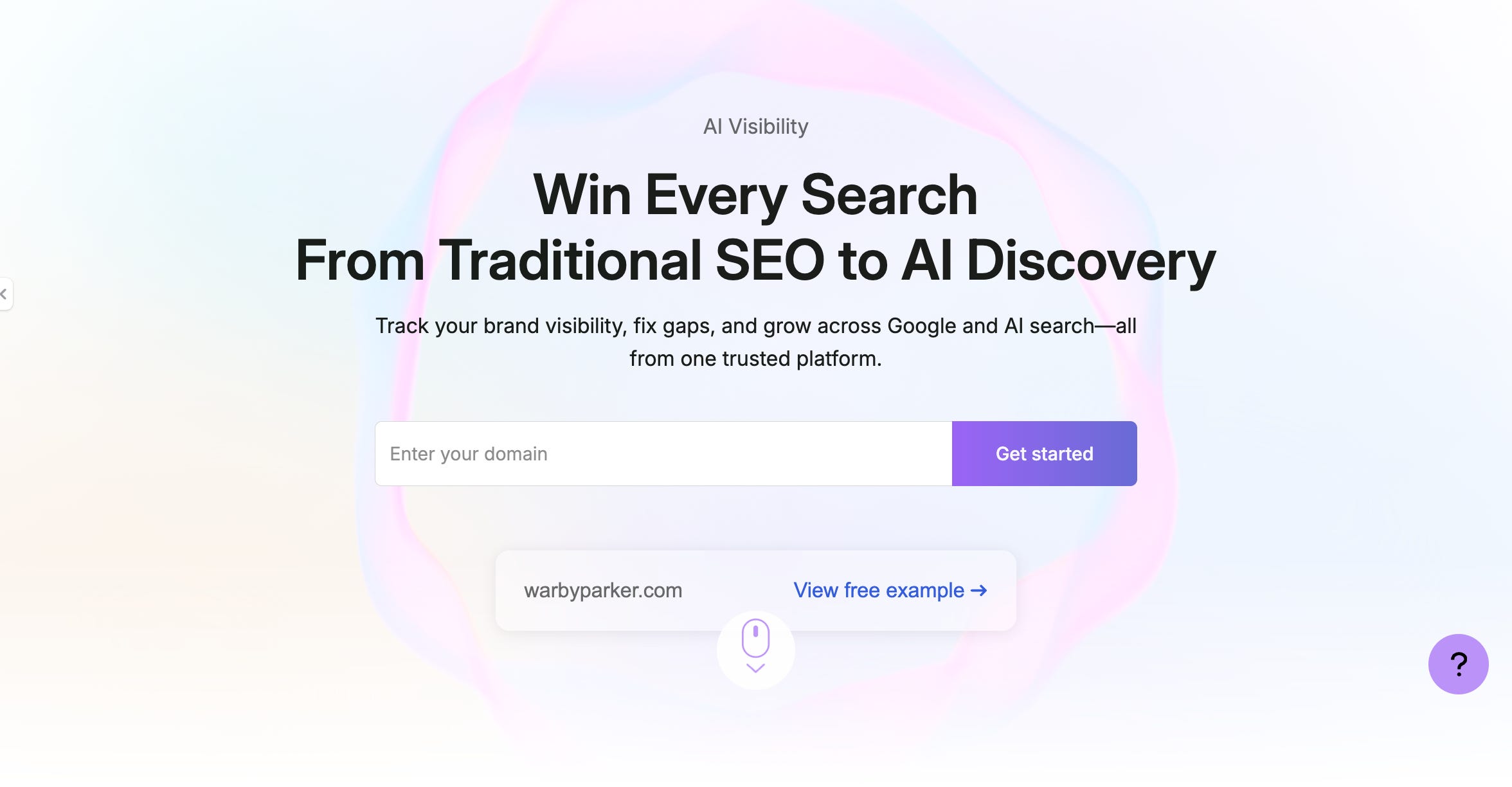
The Semrush AI Visibility Toolkit is a purpose-built platform for tracking and growing your brand’s visibility across AI search. It covers ChatGPT, Google AI Overviews, Google AI Mode, Gemini, and Perplexity in one dashboard, showing you not just where you stand but what to do about it.
What it covers:
Brand visibility scores and share of voice across ChatGPT, Google AI Overviews, Google AI Mode, Gemini, and Perplexity
Competitor gap analysis showing the exact prompts where rivals appear but you do not
Citation source tracking so you know which domains to target for content placement
Daily tracking for priority prompts, with alerts when your visibility shifts
Prompt discovery to surface what your audience is actually asking AI across industries
Sentiment tracking to see how AI platforms describe your brand and where the gaps are
Content optimization recommendations to make your site easier for AI to understand and cite
What sets it apart from standalone trackers is the connection between AI visibility and traditional SEO data. When you can see your AI share of voice alongside your keyword rankings and backlink profile, it is a lot easier to understand why you are or are not being cited, and where to focus content efforts.
A Google Analytics integration is in development, which will connect AI visibility directly to actual traffic and conversion data. That closes the loop on proving ROI for this channel.
Peec AI
Peec AI tracks daily ChatGPT visibility with share of voice, position, and sentiment metrics. All plans include unlimited seats, which makes it workable for agencies or larger teams sharing data. It also connects to Looker Studio for client-facing reporting. One gap is that there is no attribution showing how AI mentions convert to actual site traffic. Pricing starts at $89/month.
AIclicks
AIclicks covers 10+ AI platforms and includes a prompt discovery engine built on 120M+ real AI conversations, which helps surface queries you might not think to track yourself. It includes AI content generation in 100+ languages tied to visibility gaps. Worth considering for teams that want breadth across platforms rather than depth on a single one. Pricing starts at $59/month.
Omnia
Omnia adds an action layer on top of standard visibility tracking. Instead of just showing you where you rank, it generates content briefs and distribution recommendations based on which domains AI engines are citing. It tracks across unlimited countries and languages with daily refresh. Better suited to teams with an active content program who can act on those recommendations. Starts at $79/month (EUR pricing).
Scrunch AI
Scrunch AI is built for agencies and enterprise teams managing multiple brands. It runs real-time monitoring on when AI bots crawl your site, handles multi-region tracking, and breaks down competitor performance by persona, topic, and geography. One thing to note: tracking one prompt across multiple engines consumes multiple prompt credits, so costs can add up at scale. Pricing starts at $100/month.
Rankshift AI
Rankshift AI monitors brand mentions, citations, and competitor presence across ChatGPT, Gemini, AI Overviews, AI Mode, Copilot, Perplexity, Claude, Meta AI, and Mistral. A standout feature is crawler analytics, which shows exactly when AI bots visit your site and which pages are used in AI-generated answers. It also includes a content writer that analyzes LLM responses and your citation data to draft optimized content. Credit-based pricing can be harder to predict for high-volume tracking. Starts at $69/month (EUR).
Rankscale
Rankscale tracks 17+ AI engines including Google AI Mode, AI Overviews, and less mainstream platforms like DeepSeek. Broader platform count than most tools. Worth considering for teams who want full coverage of the AI search landscape rather than just ChatGPT and the major players.
Otterly AI
Otterly AI monitors brand mentions across ChatGPT, Perplexity, Gemini, and Claude with sentiment analysis and share of voice tracking. The setup process is notably clean compared to more feature-heavy enterprise tools. A practical option for smaller teams getting started with AI visibility tracking without a steep learning curve.
SE Ranking
SE Ranking has a dedicated ChatGPT Visibility Tracker that detects brand mentions and links inside AI-generated answers. It fits naturally if you are already using SE Ranking for traditional SEO and want AI visibility without adding a second platform. The AI Search add-on is $89/month on top of the base subscription, which makes the true cost a bit harder to calculate upfront.
Profound
Profound is built for enterprise. It includes a Conversation Explorer with 400M+ conversations for prompt volume and intent research, plus ChatGPT Shopping visibility tracking for e-commerce brands. The interface is complex and the learning curve is steep. Starts at $99/month but scales up significantly for larger teams.
Atomic AGI
Atomic AGI combines traditional SEO reporting with AI brand mention tracking across ChatGPT, Perplexity, and others. One distinctive feature is real-time hallucination detection, which catches cases where an AI engine is describing your brand inaccurately. The daily prompt limit of 50 prompts on the top plan makes it less practical for teams tracking a large prompt library. Starts at $20/month.
Ahrefs Brand Radar
Ahrefs Brand Radar has one of the larger AI visibility databases, with 254M+ monthly prompts sourced from real user searches rather than synthetic queries. It also connects citation data to Ahrefs’ existing backlink index, which can surface useful correlation between what gets linked and what gets cited by AI. The main barrier is pricing: $199/month per AI platform, or $699/month for all platforms. More practical for large enterprise teams already invested in the Ahrefs ecosystem.
What Makes Content Get Cited by ChatGPT
Tracking where you stand is step one. Step two is understanding what drives ChatGPT to cite some content over others.
The pattern across most research on GEO (Generative Engine Optimization) points to a few consistent factors.
Structure
Content with clear H2 and H3 headings that directly answer questions performs better in AI citations than wall-of-text content. AI models are essentially pattern-matching for sections that answer specific question types. If your content buries the answer inside long paragraphs, it is less likely to be cited.
Topical Authority
ChatGPT tends to cite sources that cover a topic comprehensively, not just in a single article. A site with 15 articles on AI visibility tracking is more likely to be cited in that topic area than a site with one listicle, even if that single article is well-written. Depth of coverage signals authority to the model.
Third-Party Directories and Review Sites
One underrated driver: AI engines heavily cite G2, Capterra, Reddit threads, industry publications, and roundup articles from high-authority domains. If you are trying to improve your ChatGPT visibility and you are not actively managing your presence on those platforms, getting featured in those third-party sources, and earning links from them, you are missing a major lever.
GPTBot Access
If your robots.txt blocks GPTBot, OpenAI’s crawler, ChatGPT cannot index your content to cite it. Check this first. It is a surprisingly common issue, especially on older sites where robots.txt was set up before these crawlers existed.
How Often to Check and What to Do When You Drop
Daily tracking dashboards create the illusion that you need to respond daily. You do not.
A practical cadence for most teams:
Weekly: review your top 20 prompts for mention rate changes of 10% or more
Monthly: run a full competitor gap analysis and identify new citation opportunities
Immediately: investigate any sudden drop in visibility on high-priority prompts
When visibility drops, the first questions to answer are: did a competitor gain citations on a domain you do not appear on? Did your site’s crawlability change? Did a third-party source that was citing you remove or update a page?
Most visibility shifts trace back to one of those three causes. The tools that make it easiest to diagnose which one are the ones worth paying for.
The Free Option Reality Check
Every tool in this space offers some version of a free trial or freemium tier. The honest answer is that free gets you a snapshot and not much more.
Manual tracking by running prompts in ChatGPT and logging results in a spreadsheet works until you hit about 10 prompts. Beyond that, you are spending two to three hours a week collecting worse data than a $50/month tool would generate automatically.
If you are not ready to pay, use the free AI Visibility Checker to get your baseline and understand the landscape, then make the call.
FAQ
Can I track my ChatGPT rankings for free?
Yes, to a point. The free AI Visibility Checker gives you a snapshot of whether AI is recommending you or your competitors right now. For ongoing tracking, competitor benchmarking, and citation data, you will need a paid tool.
How is ChatGPT rank tracking different from traditional SEO rank tracking?
Traditional rank tracking gives you a deterministic position. You are #4 on Google for a keyword, full stop. ChatGPT tracking is probabilistic. The same prompt produces different outputs across runs, so tools track how often you appear and where in the response, not a fixed position. Any tool that shows you a single “rank” number without explaining how many samples it is based on is misleading you.
Does Semrush track Google AI Overviews as well as ChatGPT?
Yes. The Semrush AI Visibility Toolkit covers ChatGPT, Google AI Overviews, Google AI Mode, Perplexity, Gemini, and more in one dashboard. See this guide for a deeper look at Google AI Overviews strategy specifically.
What is the difference between brand mentions and citations in ChatGPT?
A mention is when ChatGPT says your brand name in a response. A citation is when it references a specific URL or piece of content as a source. Citations are more valuable for optimization purposes because they tell you exactly which content is driving your AI visibility and give you a concrete target to improve or replicate.
Which AI platforms should I be tracking beyond ChatGPT?
The platforms that matter most for most businesses right now are ChatGPT, Google AI Overviews, Google AI Mode, Perplexity, and Gemini. Claude and Copilot are worth tracking for B2B audiences specifically. The tools listed above vary in how many platforms they cover, so match platform coverage to where your buyers actually spend time.