
How to Rank in AI Overviews: What Google Actually Said (and What It Left Out)
Google finally published its AI Overview playbook. The first rule contradicts everything the AI does.

For years, ranking in Google meant one thing: get a blue link as high up the page as possible. Then AI Overviews showed up, started answering questions before anyone scrolled, and quietly rewrote the rules. Searches for “AI SEO” have climbed 5,700% in the last five years as marketers scramble to figure out what changed.
Here is the strange part. Google’s AI reads and repackages the entire web to build those answers. But the same system penalizes your site for being a repackage of what is already out there. So if you want to know how to rank in AI Overviews, you have to understand a guidance document that is part instruction manual and part contradiction. Google finally published it, and there is a lot it says plainly, plus a few things it conveniently left out.
Here is what actually matters, what to ignore, and how to start showing up.
What AI Overviews mean for SEO (and why the click is disappearing)
An AI Overview is the summarized answer Google generates at the top of the results page, stitched together from multiple sources. It is helpful for searchers and brutal for publishers, because it often answers the question without sending anyone to a website.
The numbers back that up. Fewer than 1 in 5 people now reliably click the links inside an AI Overview. The traffic you used to earn from a number-one ranking is leaking away.
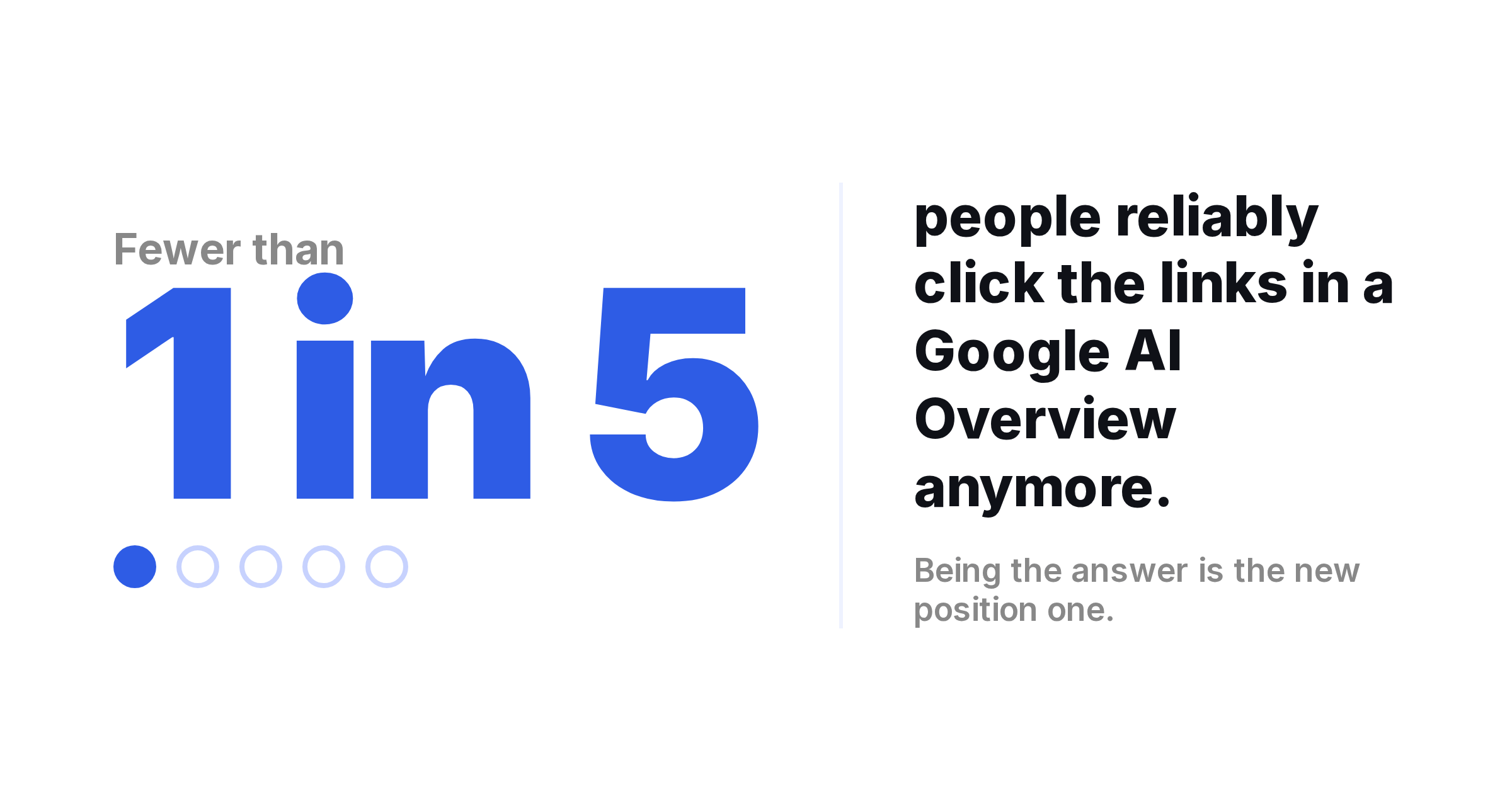
That sounds like bad news, and for the old playbook it is. But it also reframes the goal. The win is no longer just the click. It is being the source the AI pulls from and cites. Getting quoted inside the Overview is the new position one, and that is the outcome the rest of this guide is built around.
What Google actually said about optimizing for AI Overviews
Before the official guidance, SEOs were working in the dark, reverse-engineering signals through testing and a lot of guesswork. Google’s published guidance on optimizing for AI Overviews cleared up the biggest question first: this is still SEO. The fundamentals that earned you rankings before are the same ones that get you surfaced in AI Overviews. There is no separate, secret AI ranking system to game.
Then comes the catch. AI Overviews exist to synthesize and summarize the open web. Yet the system is built to reward content that does the opposite of summarizing. It wants original reporting, firsthand experience, real expertise, and a clear point of view. The more your page reads like a rehash of the top ten results, the less likely it is to become the thing those results get built from.
In other words, you do not win by writing the best summary. You win by being worth summarizing.
How to rank in AI Overviews: the content Google rewards
If you want the best practices for optimizing content for Google AI Overviews, they come down to being a primary source rather than a secondary one. Here is how to structure content for AI Overviews in a way that lines up with what Google says it favors:
Lead with original substance. Firsthand data, original research, tested results, and real experience are far harder for the AI to find elsewhere, which makes your page more quotable.
Answer the question directly and early. Clear, declarative statements near the top help the model extract a clean answer it can attribute to you.
Show real expertise. Author credibility, specific examples, and depth signal the kind of trustworthy source the system is trying to elevate.
Cover the full question, not just the keyword. Address the follow-up questions a reader would actually have, since Overviews are built around intent, not single phrases.
Keep it genuinely useful to humans first. Every piece of public guidance circles back to this. Content built for people tends to be the content that gets cited.
None of that is a trick. It is the unglamorous work of having something original to say, which is exactly why most sites skip it.
3 AI Overview optimization myths Google just debunked
A lot of the advice floating around right now is noise. Google directly pushed back on three popular tactics:
You do not need to “chunk” your content for the AI. Breaking everything into tiny machine-readable snippets is not a requirement, and obsessing over it is wasted effort.
A special LLMs.txt file buys you nothing. It does not grant priority or improve your chances of being included.
Paying for inauthentic brand mentions can backfire. Manufactured mentions are not a shortcut to visibility, and they can work against you rather than for you.
If you have been spending energy on any of these, that is energy you can redirect toward content that actually moves the needle.
What a leaked system prompt revealed that Google did not mention
Here is where you have to read between the lines. An analysis of leaked system prompts found that Google’s AI favors a confident, declarative writing style. The likely reason is that it helps the model filter out hedgy, low-substance aggregator content. The official guidance never spells this out, but the takeaway is useful: vague, wishy-washy phrasing reads as low-confidence filler, while clear and direct writing reads as a credible source.
It is a small detail with a real implication. Say what you mean, back it up, and stop softening every sentence into nothing.
Can you trust Google’s AI Overview guidance?
Mostly, yes, but not as gospel. Google has an interest in keeping the ecosystem feeding it content, so the public guidance is accurate without being the whole story. The leaked-prompt detail is a good reminder that what the system actually rewards and what the documentation describes are not always identical.
So treat the guidance as a strong starting point, then verify with your own results. Watch which of your pages get cited, which formats earn mentions, and which topics consistently trigger an Overview. Our free AI visibility checker is a quick way to see where you are already showing up. The teams that win here are the ones running their own experiments instead of waiting for the next official post.
How to start ranking in AI Overviews today
Strip away the tactics and one move survives every algorithm update: give people what they genuinely want before your competitors notice. The sites that get cited are usually the ones that covered an emerging topic early, with an original take, while everyone else was still copying last year’s winners.
That is the part you can act on immediately. Find the questions and trends your audience is starting to care about, publish a real, firsthand take before the space gets crowded, and you turn into the source the AI quotes instead of the summary it skips.
This is exactly what we built Exploding Topics to do. It scans search, TikTok, YouTube, Reddit, and more to surface trends 12 to 15 months before they go mainstream, so you can publish the original take while it is still early and rank for it before the competition shows up.
You can start spotting those trends for free today at explodingtopics.com.