
How Much Water Does AI Actually Use? The Real Numbers Behind the Panic
A query-by-query breakdown of what AI is actually costing the planet, and what's exaggerated.

Every few weeks a new claim about AI’s water problem goes viral. Sam Altman says a ChatGPT prompt costs a 1/15 of a teaspoon of water, basically nothing. Meanwhile there are stories about data centers built in drought zones, siphoning off water that towns need for drinking. Neither claim is made up. They’re just measuring completely different things, which is part of why the debate never actually resolves.
So here’s what the numbers say when you put them next to each other.
How much water does AI use, really?
AI data centers are projected to use more than 1 trillion liters of water per year by 2028, according to Morgan Stanley. That’s about 11 times what they used in 2024. But the figure is doing a lot of work, because it lumps together two very different sources.
Direct usage is water evaporated on site to cool servers. Indirect usage is the water consumed upstream to generate the electricity those servers run on. Almost nobody talks about the second one, even though it’s the bigger of the two by a wide margin. CBS News puts indirect usage at 92.54% of AI’s total water footprint.
That’s the part most coverage misses. Cooling towers are the visible villain, but the power plant three steps removed is doing most of the actual damage. It also means switching a data center to air cooling doesn’t really solve the water problem. It just relocates it.
Does AI use water on every single query?
Depends who you ask, and which model.
Altman’s own numbers put it at 0.000085 gallons of water per query, plus 0.34 watt hours of electricity, about what a lightbulb uses in a couple of minutes. That’s the fifteenth of a teaspoon figure everyone quotes.
An Association for Computing Machinery study came to a different conclusion. It found that 10 to 50 medium length GPT-3 queries were enough to use up half a liter of water, and that training the model in the first place took an estimated 5.4 million liters. Training costs get amortized differently than a single query does, self reported figures tend to look better than independently audited ones, and the two studies were never really measuring the same thing to begin with.
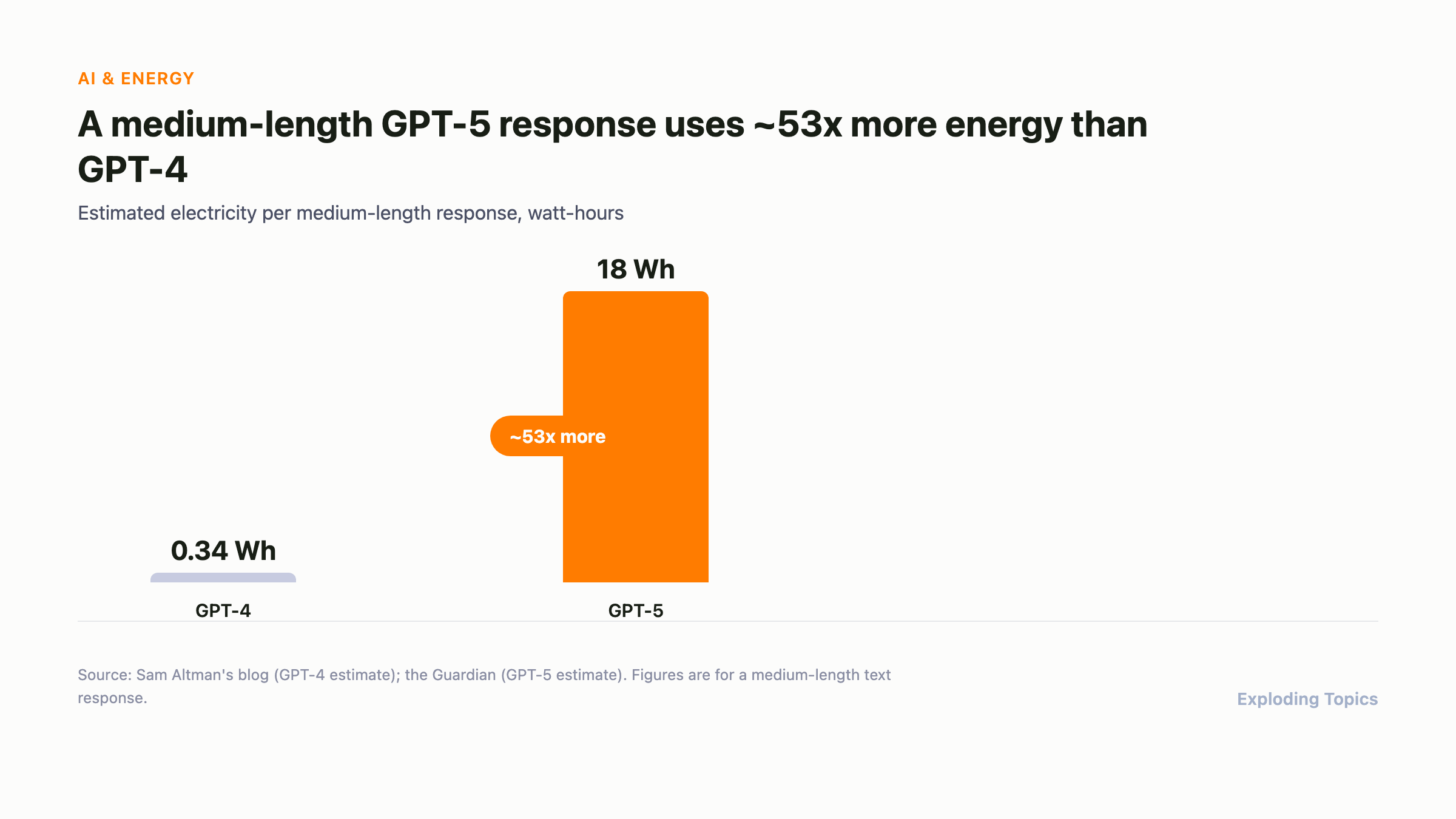
What isn’t in dispute is the direction things are moving. A GPT-5 query reportedly uses up to 20 times more energy than a GPT-4 query did. A medium response now runs about 18 watt hours, roughly 53 times what Altman cited for GPT-4 barely a year before. If energy is climbing that fast, water is climbing right along with it.
Is AI bad for the environment, or is this overblown?
Both, depending on where you’re standing.
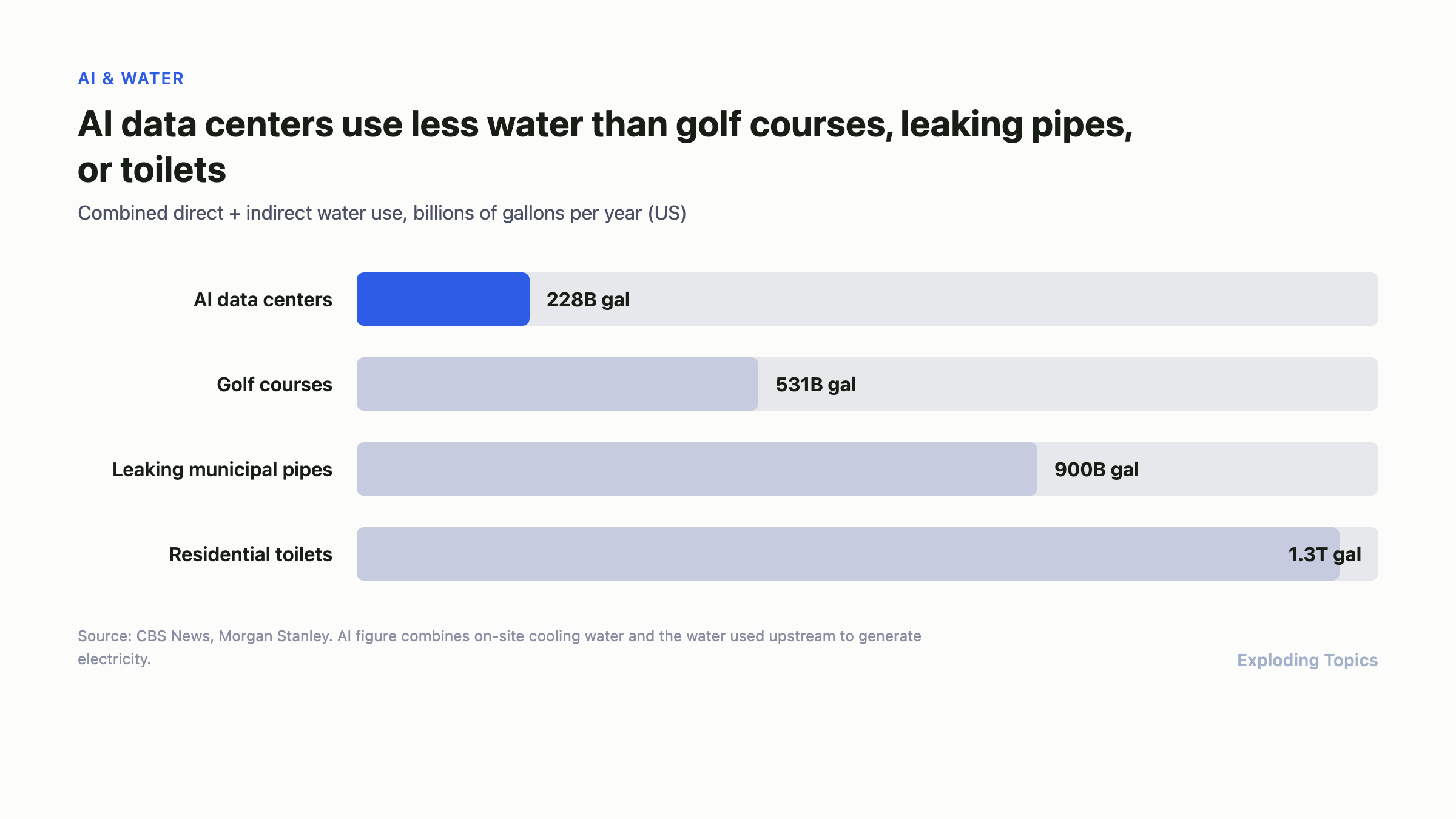
Zoomed all the way out, AI’s footprint is small. Combined direct and indirect usage puts AI data centers at roughly 228 billion gallons of water a year. That sounds enormous until you compare it to golf courses (531 billion gallons), leaking municipal pipes (900 billion), or residential toilets (1.3 trillion), all figures from CBS News. AI isn’t close to being the biggest water user in the country.
But national totals flatten out where the actual damage happens. More than half of the world’s largest data center hubs sit in areas already facing at least medium level water basin risk, per Morgan Stanley: drought, flooding, declining water quality. Nearly 68% are near protected areas or Key Biodiversity Areas, and 55% sit in river basins with elevated pollution risk, according to UK government data. Even the people building this infrastructure admit it. In an AlphaStruxure survey, 73% of data center professionals said water availability is at least somewhat slowing development, though only 21% ranked it as the single biggest constraint (permitting and utility capacity still rank higher).
So AI isn’t draining the world’s water supply so much as it’s concentrating water stress into a fairly small number of places that were already stressed. That might actually be a harder problem than a global shortage would be, since you can’t average your way out of a drought that’s happening in one specific valley.
That gap between concern and confusion is exactly the kind of shift worth watching before it becomes the story everyone’s covering. [See what other AI trends are moving before they peak →]
What about electricity and carbon emissions?
Water gets the headlines. Electricity is the bigger story.
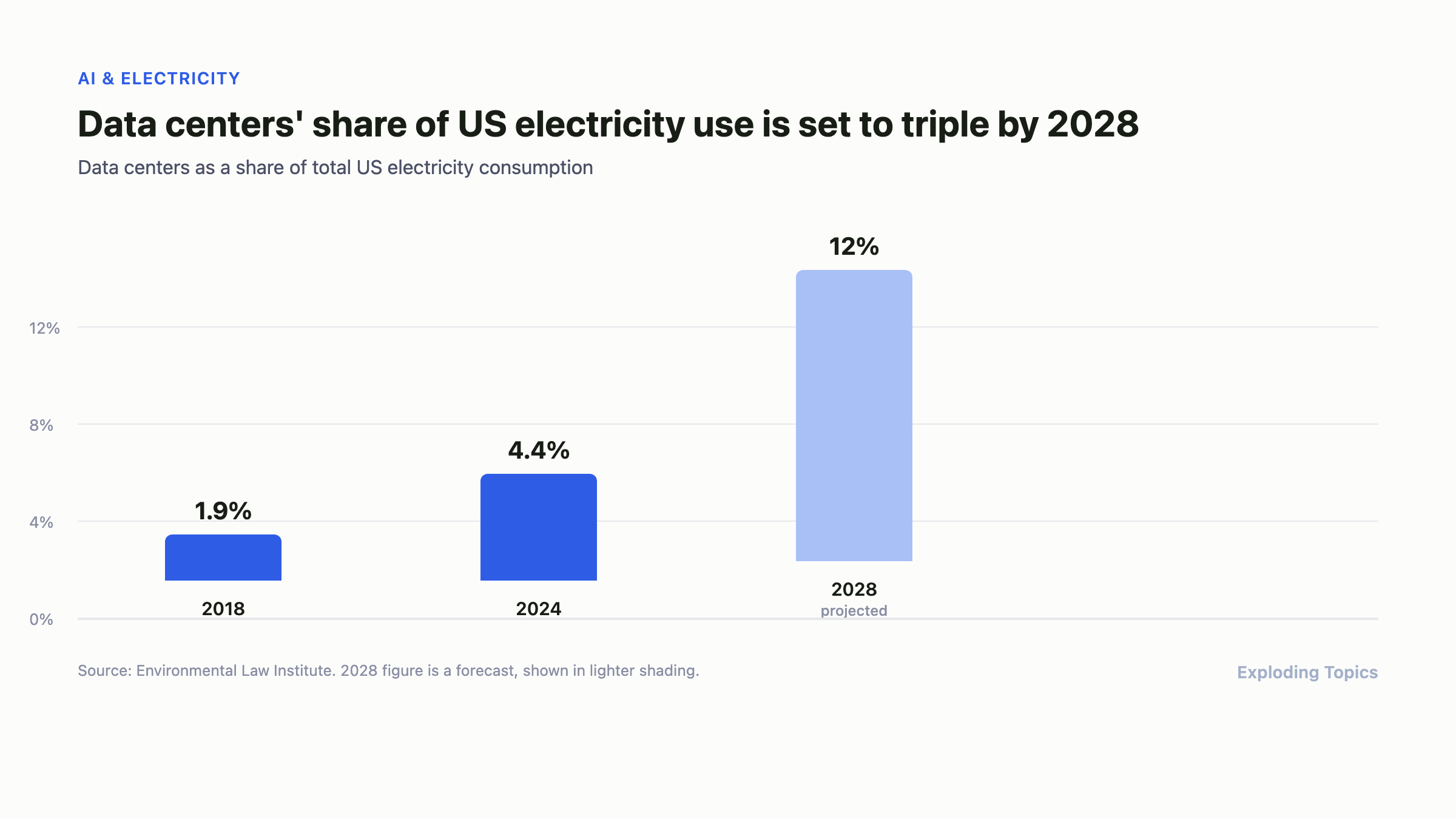
Data centers now account for 4.4% of US electricity consumption, up from 1.9% in 2018 (Environmental Law Institute), with some forecasts putting that as high as 12% by 2028. By that point, AI specific electricity demand alone, 165 to 326 terawatt hours a year, will be enough to power 22% of US households, according to MIT. The UN expects this to keep accelerating rather than plateau, since AI seems to be following the Jevons paradox: efficiency gains tend to increase total consumption rather than reduce it. Their estimate has AI reaching 3% of global electricity usage by 2030.
None of that would matter much if the grid were clean. It isn’t. Over 60% of global electricity still comes from fossil fuels, per LSE, so more AI compute still tracks fairly closely with more emissions no matter how efficient the chips themselves get.
There’s a mineral angle too that rarely gets mentioned alongside water and power. AI infrastructure could push copper demand up 72% over the coming decades, with data centers going from under 1% of global copper demand in 2024 to as much as 7% by 2050 (Business Insider estimate). Copper mining has its own water problem. One study found 92% of water treatment systems around US copper mines have failed at some point (Vermont Journal of Environmental Law).
Is there a case that AI actually helps the environment?
Yes, and it gets left out of most of these takedowns.
The International Energy Agency thinks AI driven grid modeling could unlock 175 gigawatts of additional transmission capacity just by using existing infrastructure more efficiently, without building new lines. Separately, AI weather forecasting is now up to 50% more accurate than traditional methods according to Atmo, which helps both with disaster prep and with fitting wind and solar into the grid at scale. On a smaller scale, Microsoft’s AI for Good Lab has partnered on rainforest conservation work in Colombia, where a species identification model lets researchers work about 10 times faster than manual review would allow.
That doesn’t cancel out the resource cost described above. It just means the “AI is purely extractive” framing leaves something out.
What do people actually think about this?
More conflicted than either side of the online argument would suggest. About 74% of Americans say they’re at least a little worried about AI’s environmental impact, and roughly 4 in 10 describe themselves as extremely or very worried, ahead of how people feel about cryptocurrency, air travel, or meat production.
But that worry isn’t backed by much information. 27% of consumers told Kantar they don’t feel equipped to make sustainable choices about which AI tools to use, even though 63% said they’d switch to a greener option if they could tell which one that was. That gap between concern and information is probably the more interesting finding here than any single water per query statistic.
Put it all together and the honest version is less dramatic than either side of the debate wants it to be. AI’s resource footprint is real and growing quickly. Most of it is hidden in the power grid rather than the cooling tower. The per query efficiency gains keep losing to bigger models. And the damage is landing hardest on a small number of already strained places rather than the planet as a whole. At the same time, some of that same technology is being used to forecast storms and optimize power grids. Both of those things are just going to keep being true together.
Sources: All sources for data above can be found in our original article: 28+ AI Water Usage and Environmental Impact Stats