
Can AI Replace Your Doctor? What I’ve Learned About Using ChatGPT for Medical Advice
Two thirds of Americans now ask AI for health advice. Here's what AI is genuinely good for, where it's dangerous, and whether it can replace your doctor.

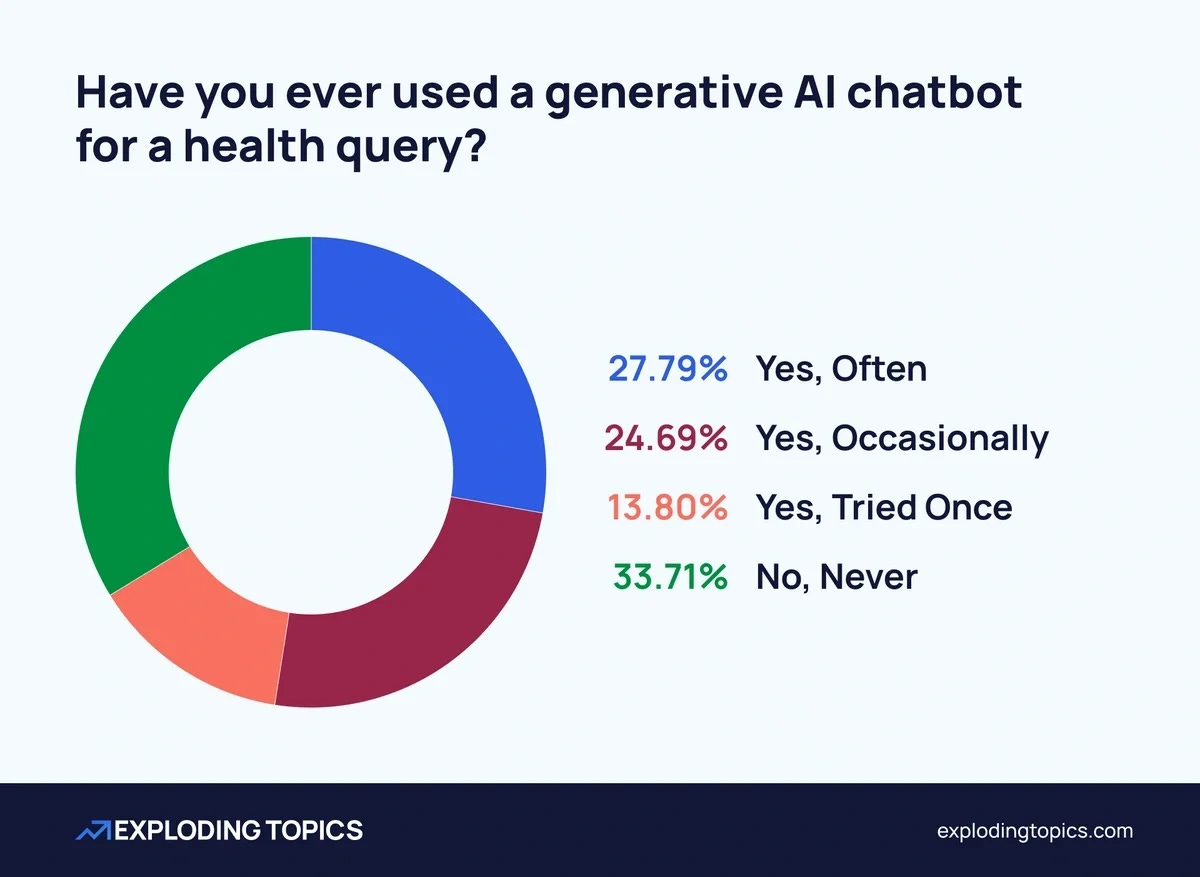
I’ll admit it: the last time I had a strange symptom, I described it to ChatGPT before I considered calling my doctor. It turns out I’m not alone. Roughly two thirds of Americans now do some version of the same thing, and most of them feel a little sheepish about it.
So I want to lay out, plainly, what AI is actually worth for your health and what it isn’t. I’ve used these tools heavily, read the research, and watched friends lean on them in ways that range from sensible to alarming. The honest picture is more interesting than either the “AI will replace your doctor” hype or the “never trust a chatbot” panic.
How common is this, really?
More common than most people assume. A survey conducted by Exploding Topics found that 66.28% had already used AI for a health question, and 27.79% did so often. Among people who use AI every day, the figure climbed to 96.9%. Once a tool is sitting open in your browser all day, asking it about a headache stops feeling like a leap.
The reasons are not mysterious. AI is free, it answers instantly, it is awake at two in the morning, and it never makes you feel as though you are wasting its time. There is no waiting room and no co-pay. For a great many people, “ask AI” has simply become the step that comes before “book an appointment.”
When they do ask, they tend to ask about three things:
Symptoms and possible conditions - which accounts for 71.49% of AI health users
Mental health and stress, at 43.83%
The health of their children and families
Is ChatGPT any good for medical advice?
It depends entirely on what you are asking it to do, and that distinction is the whole game.
Where it genuinely earns its place is in helping you understand things. Paste in a lab result or a baffling letter from your insurer and it will translate the jargon into plain English better than almost anything else available to you. It is also excellent at preparation. If you can turn a vague worry into a short list of clear questions before an appointment, you get far more out of the handful of minutes you actually spend with a clinician. And for broad, low-stakes questions, the difference between a cold and the flu it is reliable enough.
There is also something subtler that the survey captured. Eighty-two percent of AI health users said they felt listened to, a higher share than the 74.46% who felt that way about their own doctors. That finding deserves a moment’s thought rather than a victory lap. A chatbot never interrupts, never glances at the clock, and will explain the same thing three different ways without making you feel like a nuisance. For anyone who has left an appointment feeling rushed or dismissed, that experience is not trivial.
The trouble begins when people mistake understanding for judgment. AI cannot examine you. It works only from the words you type, which are often incomplete and sometimes misleading. It states its guesses in exactly the same confident tone it uses for established facts, which means it can invent a condition, a dosage, or a drug interaction without any signal that it has done so. It rarely knows your medical history, your medications, or your allergies, all of which can change the correct answer entirely. None of this is hypothetical: a quarter of users in the survey said that following AI health advice had led to a serious problem.
The line I would draw is this. AI is a fine instrument for understanding your health and a poor one for deciding what to do about it.
A word about mental health
This is the use that worries me most, because it is simultaneously the most appealing and the most dangerous.
Nearly half of AI health users, talk to AI about mental health or stress, and I understand the pull. A chatbot is private, immediate, and incapable of judging you. For ordinary stress, or for simply thinking out loud, it can be a real comfort.
But the survey found that 41.56% of people who used AI for mental health reported a serious problem as a result of following its advice, the highest rate of harm of any use it measured. The very qualities that make these tools feel supportive are the ones that make them risky in a crisis. They are endlessly patient, inclined to agree with you, and confident in their tone. A person in genuine distress does not always need to be agreed with. A trained clinician knows when to push back, when to notice a warning sign, and when reassurance is precisely the wrong response.
So by all means use AI as a sounding board for a hard week. Do not mistake it for a therapist, and never let it be your only resource when things are serious. If you are struggling, speak to a licensed professional.
In the United States, you can call or text 988 to reach the Suicide and Crisis Lifeline at any hour.
Will AI replace doctors?
I do not think so, and the people using it most heavily do not seem to want it to.
For all their reliance on these tools, users remain skeptical. Only 14.04% rate AI as completely reliable for health advice. Just 26.65% would consider using it in a medical emergency. And when it comes to advice they would genuinely trust, 64.4% still choose a human doctor.
What is happening is not replacement but the arrival of a new front door. AI is filling the gaps the system leaves open. The late-night anxiety, the “is this normal” questions, the wish to be heard without being hurried. People use it to get their bearings and then bring the consequential matters to a person.
The more plausible future is doctors who use AI rather than AI in place of doctors: clinicians leaning on it to draft notes, flag interactions, and summarize records while human judgment stays in charge of diagnosis and treatment. The fact that patients feel more heard by software than by their physicians is not evidence that the software is winning. It is a fairly damning comment on what ordinary care has stopped providing: time, attention, and the sense that someone is actually listening.
How to use it without getting hurt
A few principles have served me well, and they are simple enough to remember.
Use AI to understand, not to decide. It is excellent for “what could this mean” and unreliable for “what should I do about it.” Never act on advice about dosing, medication, or treatment without running it past a professional, because that is exactly where confident but wrong answers do the most damage. Treat the tool as a research assistant for your appointment: let it help you assemble your questions, then take those questions to a clinician. When something is urgent, worsening, or involves a child, skip the chatbot entirely. Bear in mind that conversations with consumer AI tools are not protected the way a medical record is, so share accordingly. AI is never the right tool for an emergency; for that, call your local emergency number.
Common questions
Is ChatGPT good for medical advice? It is useful for understanding symptoms, decoding jargon, and preparing for appointments, but it is not a reliable diagnostic tool. Only 14.04% of users in the 2026 survey rated AI as completely reliable, and a quarter reported a serious problem after following its advice. Use it as a starting point, never as the final word.
Can AI diagnose me? It can suggest possible conditions from the symptoms you describe, and most users do exactly that, but it cannot examine you, order tests, or weigh your full history. Confirm anything serious with a clinician.
Should I use AI for mental health support? It can help with everyday stress, but it is the riskiest health use in the data: 41.56% of people using AI for mental health reported a serious problem from following its advice. It is not a substitute for a licensed therapist and should never be your only resource in a crisis.
Will AI replace doctors? Not soon. People may feel more listened to by AI than by their physicians, but 64.4% still trust a human doctor most, and only 26.65% would use AI in an emergency. It is becoming healthcare’s front door, not its destination.
Is it safe to put my symptoms into ChatGPT? For general understanding, yes. Just remember that these tools are not bound by medical privacy rules, the advice can be confidently wrong, and one in four users report a serious problem from acting on it. Understand first, then verify with a professional.
Follow Exploding Topics in Social:
The figures in this piece come from a survey of 1,000+ Americans conducted by Exploding Topics. This article is general information, not medical advice; for any personal health concern, please consult a qualified professional.